

Schema diff
Compare schemas writes a query into a new tab. It does not compare anything itself — you run the query, and the server does the comparing.
That is a deliberate design and the dialog says so out loud: Joinery does not compare them itself — the server does, when you run it. What you get back is a result set, which means it sorts, filters, copies and exports like any other — none of which a built-in diff view would give you.
Opening it
Section titled “Opening it”| Where | What it pre-fills |
|---|---|
| A database’s right-click menu ▸ Compare Schemas… | That database as the source |
| ⌘K ▸ Compare database schemas | The focused tab’s database as the source |
Both refuse before opening if there is nothing to work with: with no connection you get Connect to a server before comparing schemas, and on a server with fewer than two databases loaded, … has only one database loaded — there is nothing to compare it to.
The comparison is always within one server. There is no cross-server compare.
The dialog
Section titled “The dialog”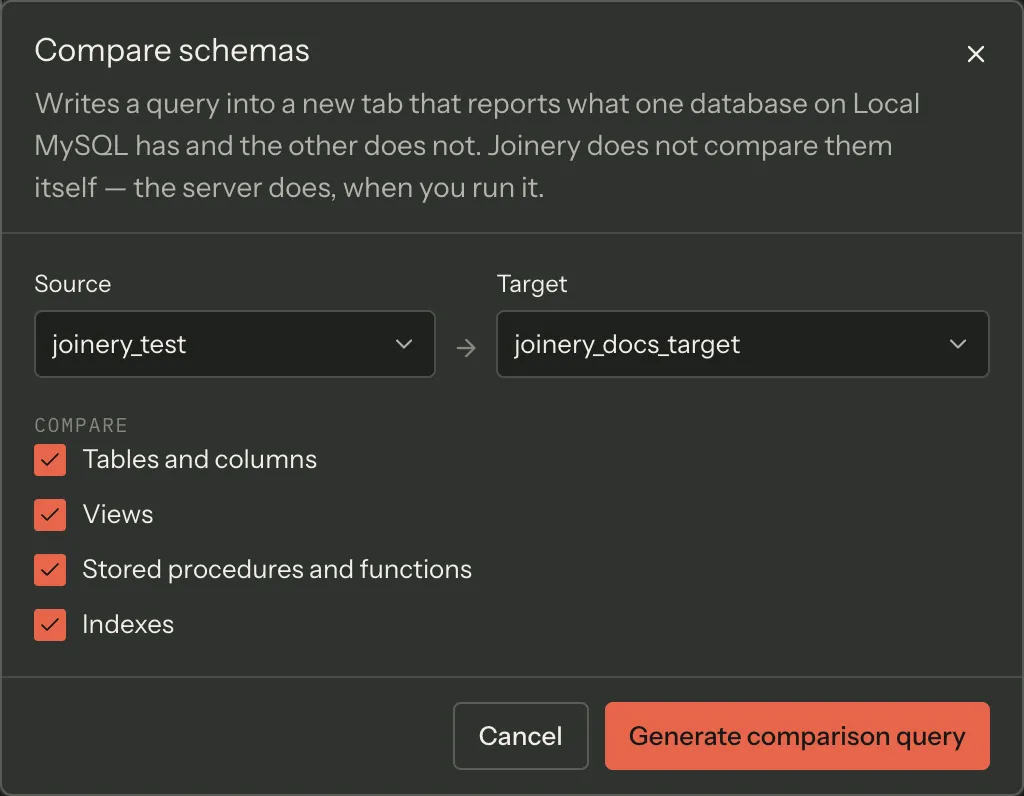
Two pickers — Source and Target — over the databases loaded for that server, and four checkboxes, all on by default:
- Tables and columns
- Views
- Stored procedures and functions
- Indexes
Generate comparison query is disabled until the form makes sense, and the reason sits beside the button rather than being left for you to guess:
| Problem | What it says |
|---|---|
| A picker is empty | Pick a source and a target database. |
| Source and target are equal | Pick two different databases — a database always matches itself. |
| Every checkbox is off | Choose at least one thing to compare. |
Pressing it opens a query tab pointed at the source database — that is where the query’s unqualified references resolve — and does not run it. Generating SQL rather than a diff is only worth anything if you can read it before it executes.
What the query looks like
Section titled “What the query looks like”A header comment naming both databases, then one banner-delimited section per box you ticked, in the order above. There is deliberately no timestamp in the header, so regenerating the same comparison produces byte-identical SQL — a saved comparison query does not show as modified just because you pressed the button again, and two runs can be diffed against each other.
Each section reports what one side has and the other does not, with a Location column naming which
database that is. The tables section additionally reports column differences inside tables both
sides have — a column missing on one side, or a type or length mismatch.
The SQL is per engine:
- SQL Server can name another database inside a query, so the comparison is one statement over
three-part
INFORMATION_SCHEMAnames, plussys.indexesfor the index section. Index names are not unique per database in SQL Server, so the index comparison matches on schema and table as well as name. - MySQL calls a database a schema and its
information_schemaspans all of them, so the same comparison becomes a self-join over twoTABLE_SCHEMAvalues, withinformation_schema.STATISTICSin place ofsys.indexes.
Database names are escaped on the way into the SQL — brackets doubled for identifiers, quotes doubled
for literals — so a database called a]b or a'b still produces a statement that parses.
Note — the routines section covers functions as well as procedures, which is why the checkbox reads “Stored procedures and functions”.
PostgreSQL
Section titled “PostgreSQL”PostgreSQL cannot query across databases, so there is no single statement to generate and Joinery does not pretend otherwise.
The menu item is still there on a PostgreSQL connection — hiding it would leave someone who read about the feature hunting for it — and the dialog opens, explains, and offers no Generate button:
PostgreSQL cannot query across databases, so there is no single statement that compares two of them. Connect to each database and compare the results, or install dblink / postgres_fdw.
Comparing two schemas inside one PostgreSQL database is a different feature and has not shipped.
Where this page's facts come from
| Claim | Source |
|---|---|
| It generates a query and the server does the comparing | packages/renderer/src/features/schema-diff/diff-query.ts:1-8 |
| The dialog’s title, description and primary-action wording | packages/renderer/src/features/schema-diff/schema-diff-dialog.tsx:81-86, 174-184 |
| A database’s menu carries “Compare Schemas…”, on every engine | packages/renderer/src/shell/sidebar/node-menu.tsx:259-268 |
| That entry pre-selects the clicked database as the source | packages/renderer/src/features/schema-diff/schema-diff-host.tsx:88-91 |
| The palette entry “Compare database schemas” uses the focused tab’s database | packages/renderer/src/commands/catalogue.ts:675-686, schema-diff-host.tsx:81-86 |
| The two pre-open refusals and their exact wording | packages/renderer/src/features/schema-diff/schema-diff-host.tsx:56-79 |
| The comparison is within one server | packages/renderer/src/features/schema-diff/schema-diff-dialog.tsx:45-56, 96-99 |
| Source and Target pickers over that server’s loaded databases | packages/renderer/src/features/schema-diff/schema-diff-dialog.tsx:105-135 |
| The four sections, their labels and their default-on state | packages/renderer/src/features/schema-diff/diff-query.ts:40-56 |
| The three disabled-reasons, shown beside the button | packages/renderer/src/features/schema-diff/diff-query.ts:87-99, schema-diff-dialog.tsx:72-76, 157-166 |
| The tab opens on the source database and does not auto-execute | packages/renderer/src/features/schema-diff/schema-diff-host.tsx:102-111 |
| Header comment, banners, and one section per ticked box in a fixed order | packages/renderer/src/features/schema-diff/diff-query.ts:101-122 |
| No timestamp, so regeneration is byte-identical | packages/renderer/src/features/schema-diff/diff-query.ts:103-106 |
| Each section reports one-side-only rows with a Location column | packages/renderer/src/features/schema-diff/diff-query.ts:148-166, 271-281 |
| Column differences are reported for tables both sides have | packages/renderer/src/features/schema-diff/diff-query.ts:168-200, 283-312 |
SQL Server uses three-part names and sys.indexes |
packages/renderer/src/features/schema-diff/diff-query.ts:19-21, 236-262 |
| The index comparison matches on table and schema as well as index name | packages/renderer/src/features/schema-diff/diff-query.ts:143-146, 244-248 |
MySQL uses a TABLE_SCHEMA self-join and information_schema.STATISTICS |
packages/renderer/src/features/schema-diff/diff-query.ts:265-268, 336-345 |
| Identifiers and literals are escaped | packages/renderer/src/features/schema-diff/diff-query.ts:348-356 |
| The routines section covers functions as well as procedures | packages/renderer/src/features/schema-diff/diff-query.ts:140-142, 218-234 |
| PostgreSQL is refused, and the exact refusal sentence | packages/renderer/src/features/schema-diff/diff-query.ts:75-82, 96 |
| The refusal renders inside the dialog with no Generate button | packages/renderer/src/features/schema-diff/schema-diff-dialog.tsx:89-102, 172-185 |
| Comparing two schemas in one PostgreSQL database has not shipped | packages/renderer/src/features/schema-diff/diff-query.ts:24-27 |